Excavator Grapple vs. Thumb: Which One Does Your Machine Need?
Thumbs and grapples both let an excavator pick up what a bucket can't. Here's how to decide which one fits your work and your budget.
Sooner or later, every excavator owner runs into material a bucket can't handle well: logs, rock, pipe, concrete chunks, brush or scrap. The two usual answers are a thumb or a grapple. Both let the machine grab and place material, but they work differently, cost differently and suit different jobs.
How a thumb works
A thumb mounts on the stick and closes against the bucket, so the bucket and thumb together act like a hand. The big advantage is that the bucket stays on the machine. An operator can dig a trench, then grab a rock or a length of pipe without changing tools.
There are two basic types:
- Mechanical (manual) thumbs are set in one of a few positions with a pin and stay arm. They are simple, inexpensive and nearly maintenance-free, but repositioning means getting out of the cab.
- Hydraulic thumbs use a cylinder so the operator can open and close the thumb from the seat. They need an auxiliary hydraulic circuit and plumbing on the stick.
Thumbs also come as weld-on (mounted under the stick) or thru-pin (sharing the bucket pin). Thru-pin thumbs follow the bucket's arc more closely and grip better through the full range of motion.
How a grapple works
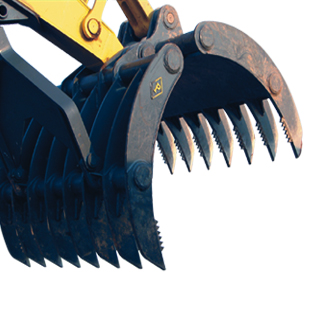
A grapple replaces the bucket. It is a dedicated material handling tool with two or more jaws, built specifically for grabbing, sorting and loading. Because it is designed for nothing but handling, a grapple usually holds larger loads more securely and is far better at sorting.
Common types include:
- Demolition grapples for C&D debris and heavy, rough material
- Sorting grapples with rotation for recycling and transfer stations
- Orange peel grapples for scrap and bulky loose material
- Log and brush grapples for forestry and land clearing
Grapples can be mechanical (driven by the bucket cylinder) or hydraulic, and many offer 360° rotation, which needs a second hydraulic circuit.
Thumb or grapple: a quick comparison
| | Thumb | Grapple | |---|---|---| | Keeps the bucket on | Yes | No | | Best for | Mixed digging and handling | Full-time handling and sorting | | Load security | Good | Excellent | | Sorting precision | Fair | Excellent, especially with rotation | | Typical cost | Lower | Higher | | Hydraulics | None (manual) or one circuit | None (mechanical), one, or two with rotation |
Which should you buy?
Choose a thumb if your machine mostly digs and only handles material part of the day. Utility contractors, excavating crews and land clearing operations that also dig get the most value from a thumb.
Choose a grapple if the machine spends most of its time handling material: demolition, scrap yards, recycling centers, transfer stations and forestry. If you sort material or load trucks precisely, rotation pays for itself quickly.
Many demolition and land clearing contractors end up owning both: a thumb on the machine that digs, and a grapple on the machine dedicated to cleanup and loading.
Buying used? Check these first
- Pins, bushings and pivot points for slop or wear
- Cylinders for leaks and scored rods
- Tines for cracks, bends or heavy wear at the tips
- Rotator condition and smooth rotation on rotating grapples
- Weld-on mounting plates for cracks (thumbs)
Our used attachment checklist covers more.
Shop thumbs and grapples
Browse excavator grapples for sale on Attachment One, or see the full line of thumbs and grapples from Pemberton.